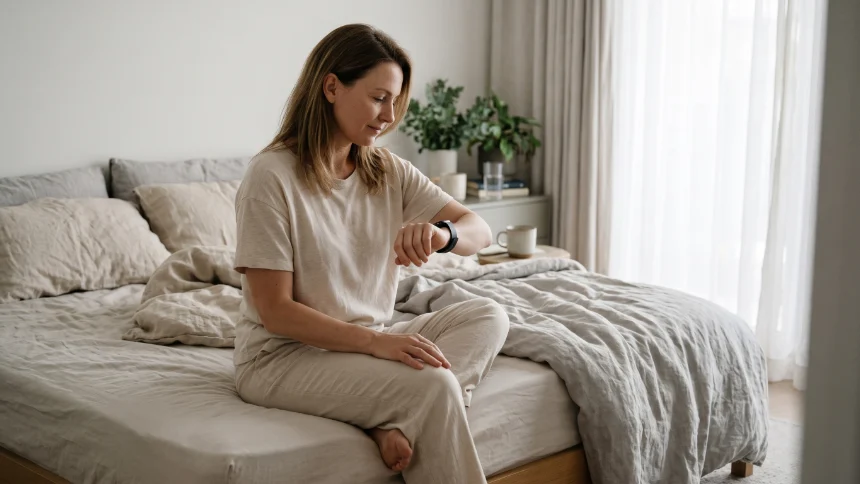
Smartwatches and fitness rings can make sleep feel measurable. Each morning, you may see a score, a breakdown of deep and REM sleep, and a recommendation for how well you recovered overnight. But what if the score says you slept poorly when you feel fine—or gives you a high score after a restless night?
Consumer sleep trackers can be useful for spotting patterns, but their numbers are estimates rather than a complete picture of what happened while you were asleep. Understanding what these devices can and cannot measure helps you use the data without letting a single score define your night.
What Does a Sleep Tracker Actually Measure?
Most wrist-worn trackers and smart rings do not measure brain activity directly. Instead, they combine signals such as movement, heart rate, heart rate variability, and sometimes skin temperature or blood oxygen estimates. Their software uses these signals to infer when you are likely asleep or awake and to estimate different sleep stages.
This approach is convenient because it allows people to collect data at home over many nights. It is also indirect. A device is making an informed prediction from body signals, not observing every aspect of sleep itself.
By comparison, clinical polysomnography records several types of physiological activity, including brain waves, eye movements, muscle activity, breathing, and oxygen levels. It is used to assess sleep disorders when clinically indicated. A consumer wearable is not a miniature version of this test.
Why Deep Sleep and REM Numbers Can Be Misleading
Sleep trackers often divide the night into light sleep, deep sleep, and rapid eye movement (REM) sleep. These categories are meaningful in sleep science, but accurately identifying them requires more than detecting movement or changes in pulse.
A 2026 rapid review of 29 studies examining consumer sleep devices in real-world settings found that devices generally performed better at estimating total sleep time than at identifying sleep stages. Estimates of REM and deep sleep were particularly unreliable, and accuracy varied across devices and populations.
That does not mean every reading is useless. It means a result such as “only 35 minutes of deep sleep” should not automatically be treated as a precise measurement—or as evidence that something is wrong.
Two devices can also produce different estimates for the same night. Their sensors, algorithms, definitions, and software updates may differ. Even when a tracker provides a precise-looking number, the display can be more exact than the underlying measurement.

Can a Tracker Tell You Whether You Slept Well?
Not on its own. Sleep quality includes more than the number of minutes assigned to each stage. It also involves how easily you fall asleep, whether you wake repeatedly, how rested you feel, and how well you function during the day.
A tracker may estimate that you were asleep for eight hours, but that figure does not necessarily explain why you feel refreshed—or why you feel exhausted. Conversely, a device may report less deep sleep than expected even when you feel alert and function normally.
Research comparing wearable metrics with people’s own assessments of sleep quality has found that the two do not always agree. A score can capture some useful information while missing the experience that matters most to the person wearing the device.
It is reasonable to use both sources: what your tracker estimates and how you actually feel. Neither needs to be treated as infallible.
When Sleep Tracking Becomes Another Source of Stress
For some people, checking sleep data encourages helpful habits. For others, it creates pressure to achieve a perfect score. They may start worrying about their sleep before bedtime, repeatedly checking the app, or feeling tired simply because the device reports a poor night.
Researchers and clinicians sometimes use the term “orthosomnia” to describe an unhealthy preoccupation with achieving ideal sleep metrics. It is not a formal diagnosis that applies to everyone who tracks sleep, but it captures a real concern: trying too hard to optimize sleep can make sleep itself more stressful.
One low score does not mean you have damaged your health, and a perfect score does not guarantee that every aspect of your sleep was ideal. Sleep naturally varies from night to night.
If checking the app makes you anxious, consider hiding the daily score, turning off morning notifications, or taking a break from tracking. The technology should support your well-being, not become another test you feel compelled to pass.
How to Use Sleep Data More Wisely
Look for patterns across several weeks. A consistent change in bedtime, wake time, or estimated sleep duration may be more informative than a single unusual reading. Avoid drawing conclusions from one night of data.
Compare the numbers with your daytime experience. Notice whether you feel alert, sleepy, irritable, or unable to concentrate. Record those observations alongside the data if doing so feels helpful. The goal is to understand your routine, not to chase a perfect score.
Keep the device and routine reasonably consistent. Wear the tracker as instructed and follow the manufacturer’s guidance for fit and charging. Changes in device placement, settings, or software can affect the readings, so avoid assuming that every change reflects a real change in your body.
Focus on habits you can control. A regular wake time, sufficient opportunity for sleep, a comfortable and quiet bedroom, and a relaxing wind-down routine are more actionable than trying to manipulate a deep-sleep percentage. Limit late-day caffeine if it affects you, and consider how alcohol or late heavy meals influence your rest.
Use trends as conversation starters, not diagnoses. If you repeatedly notice concerning patterns, you can bring a short summary of your observations to a healthcare professional. Do not rely on a consumer device to rule out a sleep disorder or to confirm one.

When Should You Seek Medical Advice?
Persistent symptoms matter more than a single wearable score. Consider speaking with a healthcare professional if you regularly have difficulty sleeping, experience significant daytime sleepiness, or remain unrefreshed despite allowing enough time for sleep.
Loud habitual snoring, witnessed pauses in breathing, gasping during sleep, or morning headaches can also warrant assessment for a possible sleep-related breathing problem. A wearable’s reassuring score cannot reliably exclude such a condition.
If a tracker repeatedly flags unusual readings, treat them as a reason to consider the wider context—not as proof of a disease. A clinician can evaluate your symptoms, medical history, medications, and whether a formal sleep assessment is appropriate.
The Most Useful Sleep Metric May Be How You Feel
Sleep trackers are best viewed as tools for observing possible trends, not as judges of whether you had a good night. They can help you notice routines and changes, but their estimates—especially sleep-stage breakdowns—have meaningful limitations.
If the data helps you make sensible adjustments and feel better during the day, it may be serving you well. If it makes you anxious, distracts you from your own experience, or encourages you to diagnose yourself, it may be worth stepping back.
The aim is not to win a sleep score. It is to get consistent, restorative rest and feel able to live your day.